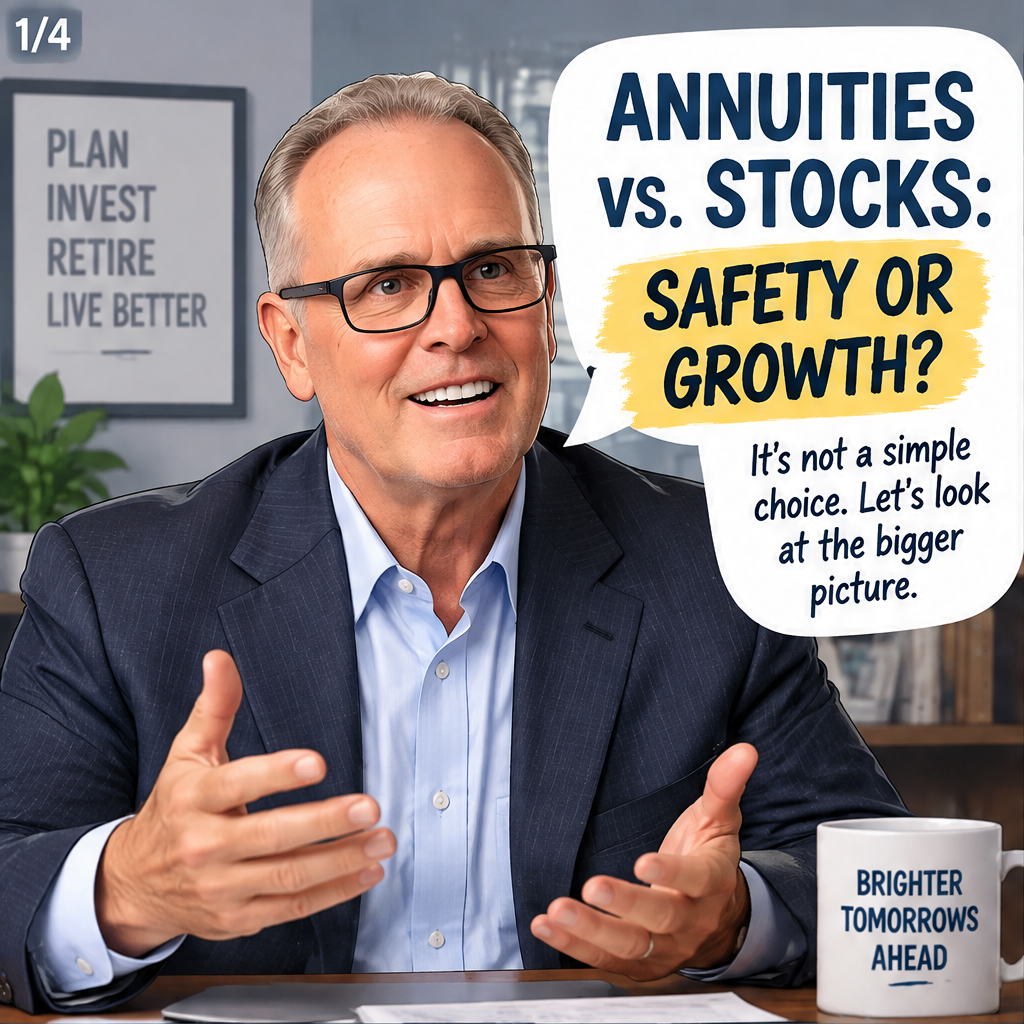
• Annuities vs. Stocks: Safety or Growth?

    Annuities vs. Stocks: Safety or Growth?

    Choosing between an annuity and the stock market is not simply a choice between “safe” and “risky.” Annuities may provide predictable income and, depending on the contract, protection from market losses. Stocks offer long-term growth potential, but their values can fluctuate significantly and losses may occur when money is needed most.

    Before purchasing an annuity, review the contract carefully. Consider surrender charges, administrative and investment fees, inflation risk, liquidity limits, payout terms, and the financial strength of the issuing insurance company. Guarantees depend on the insurer’s claims-paying ability, so they are not identical to government insurance.

    A diversified strategy may combine guaranteed income sources with investments designed for long-term growth. The right balance depends on your retirement timeline, spending needs, tax situation, emergency savings, and tolerance for market volatility. Avoid making a decision based on fear or promises of effortless returns.

    Your next step is to compare solutions objectively. Ask a fiduciary financial professional to explain costs, risks, tax treatment, and alternatives in plain language before moving forward. This content is educational and not individualized financial advice.


    Continue to full article

  • Tours of The Geysers

    Tours of The Geysers

    On November 7, 2026, community members can learn more about one of the region’s most distinctive energy resources during Tours of The Geysers. The scheduled tour departs from the Calpine Geothermal Visitor Center in Middletown and offers an opportunity to see the geothermal area while connecting local infrastructure with everyday energy needs.

    For residents interested in finance, sustainability, or regional economic development, the tour can provide useful context. Geothermal power highlights how long-term infrastructure investment, reliable generation, and environmental stewardship can intersect to support community resilience.

    Before making plans, review the official event information and confirm current availability, arrival instructions, and participation requirements. The published notice currently indicates that the 2026 tour is sold out, so interested residents should monitor geysers.com for updates, changes, or future tour opportunities.

    Save the date, share the information with neighbors, and keep the conversation going about local energy resources. Official details are available at https://geysers.com/wp-content/uploads/2025/12/2026-Calpine-Tours-of-The-Geysers-sold-out.pdf.

    Continue to full article

  • Three Steps Before Choosing Income

    Before settling on an income strategy for retirement, it’s important to weigh your options carefully. For instance, a five-fund portfolio of $665,000 earning around 4.5% could produce about $2,500 a month—comparable to, or even better than, many immediate annuity quotes—while keeping your principal working for you. As someone who’s spent over 30 years guiding clients through annuity and income decisions, I know firsthand how critical it is to balance certainty and flexibility. Annuities provide steady lifetime checks, but with a single-life contract and no refund provision, there may be nothing left for heirs. And with inflation averaging around 3%, a fixed $2,500 monthly payment will only have the buying power of about $1,900 after ten years. On the other hand, dividend growth funds might start lower—about $1,900 per month—but can grow over time, helping to keep pace with living costs, while higher-yield options can start closer to $3,300, though growth may be slower. A sensible approach is to compare immediate annuity quotes, both with and without cash refunds. You might find it makes sense to use an annuity to cover essential bills and invest the rest for flexibility and potential growth.

  • U.S. Annuities Could Lift Income 23%

    A recent study highlights the powerful role annuities can play in retirement income planning. By placing about 30% of your savings into a single premium immediate annuity and using standard withdrawals for the rest, retirees saw an average income increase of approximately 23%. For example, with $1 million saved, this blend provided $49,300 per year instead of $40,000 from withdrawals alone. Even a near-7% annuity could match $40,000 in income with just $563,000 invested. These annuities involve a lump-sum payment near retirement, then deliver guaranteed income for life, tailored to market conditions and personal factors. Yet, despite these advantages, only around 10% of older Americans own an annuity, though over half with more than $100,000 in savings want lifetime guaranteed income. It's important to weigh tradeoffs like limited liquidity, potentially higher fees, and death benefit restrictions. As someone who has specialized in annuities and universal life for more than three decades at Neasham Insurance Agency, I’ve seen how the right strategy can create lasting security in retirement.

  • ETF vs. Fixed Indexed Annuity: Build Your Path to Guaranteed Lifetime Income

    ETF vs. Fixed Indexed Annuity: Build Your Path to Guaranteed Lifetime Income

    Choosing between an exchange-traded fund (ETF) and a fixed indexed annuity (FIA) depends on what you need your money to do. ETFs provide diversified market exposure, daily liquidity, and flexibility, but their values fluctuate and withdrawals are not inherently guaranteed for life.

    Fixed indexed annuities are insurance contracts designed to offer interest potential linked to an external market index, typically with protection from direct market losses. Contract features such as caps, participation rates, spreads, surrender charges, and optional riders can affect results, so reviewing the details is essential.

    For retirees focused on predictable cash flow, an annuity may provide guaranteed lifetime income according to the contract and selected options. ETFs can complement that strategy by supporting liquidity, long-term growth, and legacy goals, but sustainable withdrawals require thoughtful planning.

    Before making a decision, compare costs, taxes, access to funds, inflation risk, insurer financial strength, and your overall retirement objectives. A qualified financial professional can help evaluate whether one approach—or a combination—fits your circumstances. Guarantees depend on the claims-paying ability of the issuing insurer, and this content is for educational purposes only.

    Continue to full article

  • US Retirees Revisit Spend-It-All Strategy

    As someone who’s spent over 30 years helping clients navigate retirement planning at Neasham Insurance Agency, I often see the appeal of the 'spend-it-all' retirement mindset. It’s understandable — many retirees end up spending less than the traditional 4% withdrawal guideline, sometimes even holding onto all their original assets well into retirement. Still, memorable experiences and the joy of gifting can bring lasting value in these years. But here’s the challenge: a recent survey shows about 50% of Americans don’t have a written financial plan. Without careful budgeting and savings, this approach can easily go off track. It’s also important to consider that spending and gifting earlier can impact tax efficiency; larger withdrawals may trigger unexpected taxes, and heirs may miss out on the step-up in basis. One effective strategy I’ve seen is purchasing permanent life insurance earlier in life. This not only allows retirees to enjoy their savings but also provides loved ones with a tax-free benefit — and policy values can be accessed if needed. Smart planning can help you enjoy your retirement while still protecting your legacy.

  • 401(K) Bill Could Create Lifetime Income

    There’s been an interesting development around 401(k) plans and annuities that’s worth keeping an eye on. Lawmakers proposed allowing workers aged 50 and older to direct a portion of their 401(k) into an annuity, while still employed and receiving employer contributions. This was a targeted change: it wouldn’t have allowed broad early withdrawals, but would have created a specific path for those considering guaranteed income options as part of their retirement plan. The proposal also aimed to make rollover notices clearer, after audits revealed many folks misunderstood their options. While many see the appeal of securing lifetime income, it’s crucial to weigh the tradeoffs—fees, reduced liquidity, the financial health of insurers, and how inheritance is handled all come into play. For now, nothing changes until Congress acts and employers add this feature to their plans, so it’s a good time to review your savings strategy and stay informed about what might be coming. After more than 30 years helping clients navigate annuities and retirement income planning, I know how important it is to fully understand these shifts before making any decisions.

  • How Much Can a $50,000 Annuity Pay?

    After decades helping clients explore their annuity options, I’m often asked what a $50,000 immediate annuity can really provide. The answer isn’t one-size-fits-all—it depends on your age at purchase, and the type of payout you choose. Older buyers usually receive higher monthly payments, since insurers anticipate a shorter payout period. Opting for a single-life annuity brings a larger monthly check, while joint-life or guaranteed period options offer more protection but reduce the income a bit. When planning for retirement, the real question becomes: will this steady annuity income fill the gap left after Social Security, pensions, and other sources are counted? It’s also important to remember that income annuities mean limited access to your original lump sum—so keeping emergency funds and comparing contracts carefully is essential. With over 30 years guiding clients through these choices at Neasham Insurance Agency, I believe in finding the balance between security and flexibility for every retirement plan.

  • FIRE vs. Micro-Retirement: Which Financial Plan Will Help You in the Long Term?

    FIRE vs. Micro-Retirement: Which Financial Plan Will Help You in the Long Term?

    There’s a lot of discussion these days around FIRE—aggressive saving to retire early—and micro-retirement, which is about taking intentional breaks from work to maintain balance over a lifetime. Both approaches have their merits, but a hybrid strategy can provide the flexibility many people seek. With over 30 years as the owner and operator at Neasham Insurance Agency, I’ve seen how important it is to align your financial planning—be it through annuities, universal life policies, or retirement strategies—with your unique goals and comfort with risk. A thoughtful, personalized approach makes a real difference in building the future you want.

    Continue to full article

  • A New Age In Retirement: Why Annuities May Be A Promising Path For Millennials And Gen X

    A New Age In Retirement: Why Annuities May Be A Promising Path For Millennials And Gen X

    Retirement planning looks different for Gen X and millennials. With only 14% of private workers covered by defined-benefit plans, the path forward can feel uncertain. Add in rising healthcare costs, inflation, and the reality of living longer—it's no surprise more people are looking at annuities to provide stable, guaranteed income. Having spent over 30 years specializing in annuities and universal life at Neasham Insurance Agency, I see firsthand how these solutions can bring clarity and confidence to your long-term plan.

    Continue to full article